


A few years ago, the question sounded simple:
“Where can I get a crypto license?”
In 2026, that is no longer the right question.
The better question is:
“Which regulatory ecosystem do I want my crypto business to grow inside?”
That distinction matters.
A crypto license is no longer just a legal checkbox between incorporating a company and launching a product. Regulation increasingly determines who you can serve, which financial infrastructure you can access, how institutions perceive your business, and how easily you can scale across borders.

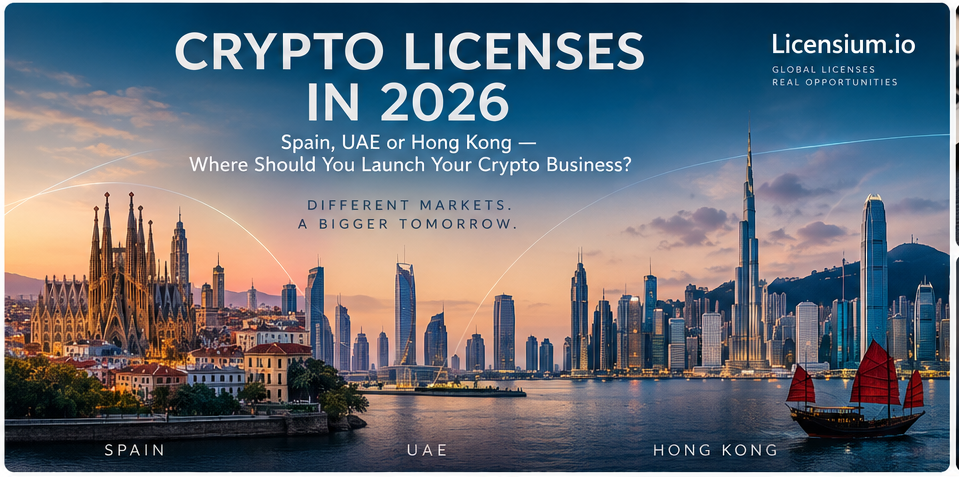
Three jurisdictions stand out in this race: Spain, the UAE, and Hong Kong.
They are all moving toward regulated digital-asset markets. But they are pursuing very different strategies.
Spain is building around European integration.
The UAE is building around global capital and international business.
Hong Kong is building around the integration of digital assets with Asia's existing financial system.
So the interesting question is not which jurisdiction is “crypto-friendly.”
It is which one is building the ecosystem your business will actually need.
Three Markets, Three Different Bets
Consider a crypto company preparing to launch an exchange, brokerage platform, custody business, or digital-asset investment service.
It could enter Europe through Spain.
It could establish itself in Dubai and target international markets.
Or it could build an Asian presence through Hong Kong.
At first glance, the licensing processes may look similar.
Regulators want to see competent management, AML/KYC controls, governance, risk management, technology infrastructure, financial resources, and customer protection.
But the strategic outcome can be very different.
That is why choosing a jurisdiction based purely on licensing cost or speed can be misleading.
The license is only one piece of the puzzle.
The ecosystem around it may matter much more.
Crypto License in Spain: The European Bet
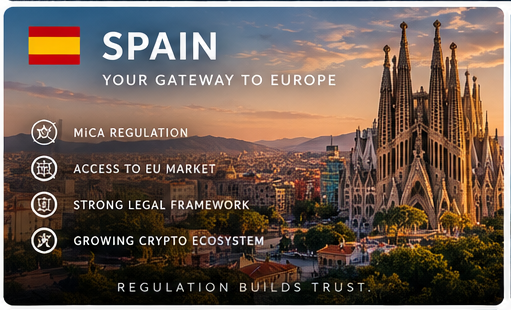
Spain is particularly interesting because of its position within the European Union's MiCA framework.
MiCA — the Markets in Crypto-Assets Regulation — has created a harmonized regulatory framework for crypto-asset service providers across the EU.
Spain's regulatory architecture is therefore increasingly connected to a much larger market.
This changes the equation.
A crypto license in Spain is not simply about operating in Spain.
For the right business model, it is about building within the European regulatory framework.
That distinction could become increasingly valuable as the European market matures.
Under MiCA, regulated crypto-asset service providers face requirements covering areas such as governance, operational resilience, customer protection, conflicts of interest, custody, AML/KYC and risk management.
The direction of travel is clear:
Crypto in Europe is moving away from the experimental phase and toward becoming another regulated financial industry.
That may make the market more demanding.
But regulation can also create something startups rarely have in their early years:
credibility.
For a company targeting European customers, institutional partners or long-term expansion across the EU, that credibility may ultimately be worth more than a cheaper registration somewhere else.
Crypto License in the UAE: The Global Hub Strategy
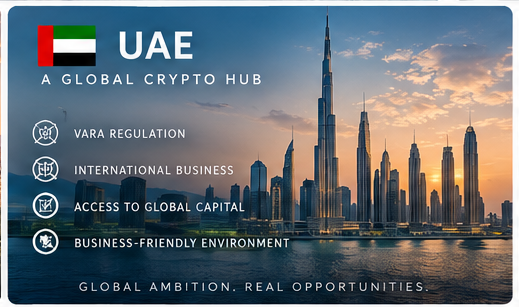
If Spain's strategy is European integration, the UAE's strategy is different.
The UAE is positioning itself as an international hub for digital assets, with Dubai at the center of much of that activity.
The Dubai Virtual Assets Regulatory Authority — VARA — regulates virtual-asset activities in Dubai and requires companies conducting regulated virtual-asset activities to obtain the appropriate authorization.
Importantly, there isn't simply one generic “crypto license.”
The regulatory framework is built around specific activities, including brokerage, custody, exchange, advisory, lending and borrowing, management and investment, transfer and settlement, and other regulated activities.
That is significant.
The regulator is effectively asking:
What exactly are you building?
Not simply:
“Are you a crypto company?”
This is a much more mature way of looking at the sector.
A crypto exchange, custody provider and investment manager create different risks for customers and therefore require different regulatory frameworks.
The UAE's appeal goes beyond the license itself.
Dubai offers an ecosystem built around international companies, capital, financial services, technology and cross-border business.
That makes a crypto license in the UAE particularly compelling for companies that are thinking globally from day one.
But there is an important caveat.
A UAE license does not mean “easy mode.”
Regulators expect serious operational preparation: business plans, governance structures, risk and compliance frameworks, information about shareholders and management, financial projections, capital requirements and plans for how the business would wind down in an orderly way.
In other words:
Incorporating a company is easy. Building a regulated financial company is not.
And that is exactly why the license can have value.
Crypto License in Hong Kong: The Asian Financial-Market Bet
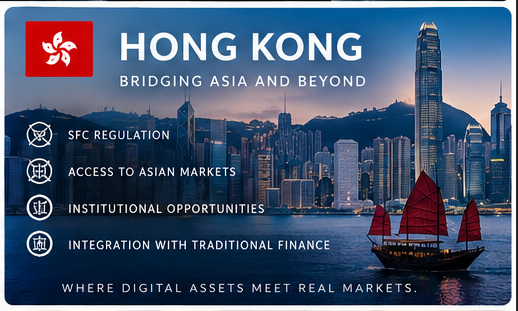
Hong Kong is taking yet another approach.
Here, digital assets are being integrated more directly into the existing financial system.
The Securities and Futures Commission, or SFC, oversees the licensing regime for virtual asset trading platforms.
This creates a different kind of proposition.
Hong Kong is not simply trying to become a place where crypto companies can operate.
It is trying to establish a regulated digital-asset market that can coexist with — and potentially connect to — traditional finance.
That distinction matters for institutional businesses.
Hong Kong has continued expanding its regulatory framework around virtual assets, including developments involving custody, trading platforms, stablecoins and other digital-asset services.
In 2026, the regulatory conversation is moving beyond the basic question of whether crypto should be regulated.
The conversation is increasingly:
How should digital assets fit into the architecture of modern finance?
That is a much bigger question.
And it explains why a crypto license in Hong Kong may be particularly attractive to businesses targeting Asia, institutional investors, digital-asset infrastructure and tokenization.
Hong Kong is effectively making a long-term bet that digital assets will not remain a separate financial universe.
They will become part of finance itself.
So Which Jurisdiction Wins?
If you strip away the marketing, the picture becomes surprisingly simple.
Spain makes sense for businesses whose strategic center of gravity is Europe.
The UAE makes sense for companies looking for an international hub and access to global capital.
Hong Kong makes sense for businesses targeting Asia and the intersection between digital assets and traditional finance.
But there is no universally “best” crypto license.
There is only a license that fits your strategy better.
An exchange is not the same business as a custody provider.
A brokerage platform is not the same business as an investment manager.
A token issuer is not the same business as a payments company.
The regulatory footprint changes with the business model.
And that is why comparing jurisdictions only by price is a little like choosing an airport based on parking fees.
It tells you something.
Just not the thing that matters most.
| Jurisdiction | Best strategic fit | Licensing route | Explore the guide |
|---|---|---|---|
| Spain | EU customers, MiCA framework and European institutional credibility | Crypto-asset services within the EU framework | Crypto license in Spain |
| UAE | International hub, global capital and Dubai-based operations | Activity-based VARA authorisation | Crypto license in the UAE |
| Hong Kong | Asia, institutional investors and traditional-finance integration | SFC virtual asset trading platform regime | Crypto license in Hong Kong |
The Bigger Trend: Regulation Is Becoming a Competitive Advantage
Perhaps the most interesting development in crypto regulation is not a particular rule.
It is the changing perception of regulation itself.
During crypto's early years, the value proposition was often about operating outside traditional financial systems.
That narrative is changing.
As the industry matures, regulation can become a gateway to things that crypto businesses increasingly need:
banking relationships, institutional capital, larger counterparties, professional investors and mainstream financial infrastructure.
This creates an interesting competitive dynamic.
Spain, the UAE and Hong Kong are not simply competing for crypto companies.
They are competing to become part of the next generation of financial infrastructure.
And that changes the role of the license.
A license is no longer just permission to operate.
It can become a signal.
A signal to customers.
A signal to banks.
A signal to institutional partners.
And, perhaps most importantly, a signal to the market that a company intends to build something that survives the next cycle.
Spain, UAE or Hong Kong? The Short Answer
If your strategy is Europe, a crypto license in Spain deserves serious consideration, particularly within the broader MiCA framework.
If you want an international base with a strong digital-asset ecosystem, a crypto license in the UAE may be the more natural fit.
If your ambition is Asia, institutional capital and the convergence of digital assets with traditional finance, a crypto license in Hong Kong becomes particularly interesting.
But perhaps the most useful question is not:
“Which country has the best crypto license?”
Ask instead:
“Where do I want my crypto business to be five years from now?”
Because obtaining a license is a short-term milestone.
Choosing the regulatory ecosystem around which you build the company is a long-term decision.
And in 2026, that decision is becoming one of the most important strategic choices a crypto founder can make.

Authoritative regulatory sources
- EUR-Lex — Regulation (EU) 2023/1114 on markets in crypto-assets (MiCA)
- CNMV — MiCA: New regulation for crypto-assets
- VARA — Licensed Virtual Asset Activities
- VARA Rulebook — Virtual Assets and Related Activities Regulations 2023
- SFC Hong Kong — Virtual asset trading platform operators
- HKMA — Regulatory regime for stablecoin issuers
Regulatory frameworks change frequently. This article is general information, not legal advice or a guarantee of authorisation. Confirm the current requirements with the relevant competent authority before relying on any statement about licensing, market access or transitional rules.