


Market research · Crypto licensing · November 2026
Since 1 July 2026 the European Union no longer has a grace period for crypto-asset service providers. Some founders have decided the answer is to leave. They are asking a fair question: where can a crypto business go now? The honest answer has two halves. Moving the company is easy. Moving the rules that attach to your customers is not. This guide, written the way a lawyer would brief a founder, explains the difference, compares the regimes that actually work and shows which one fits which business.
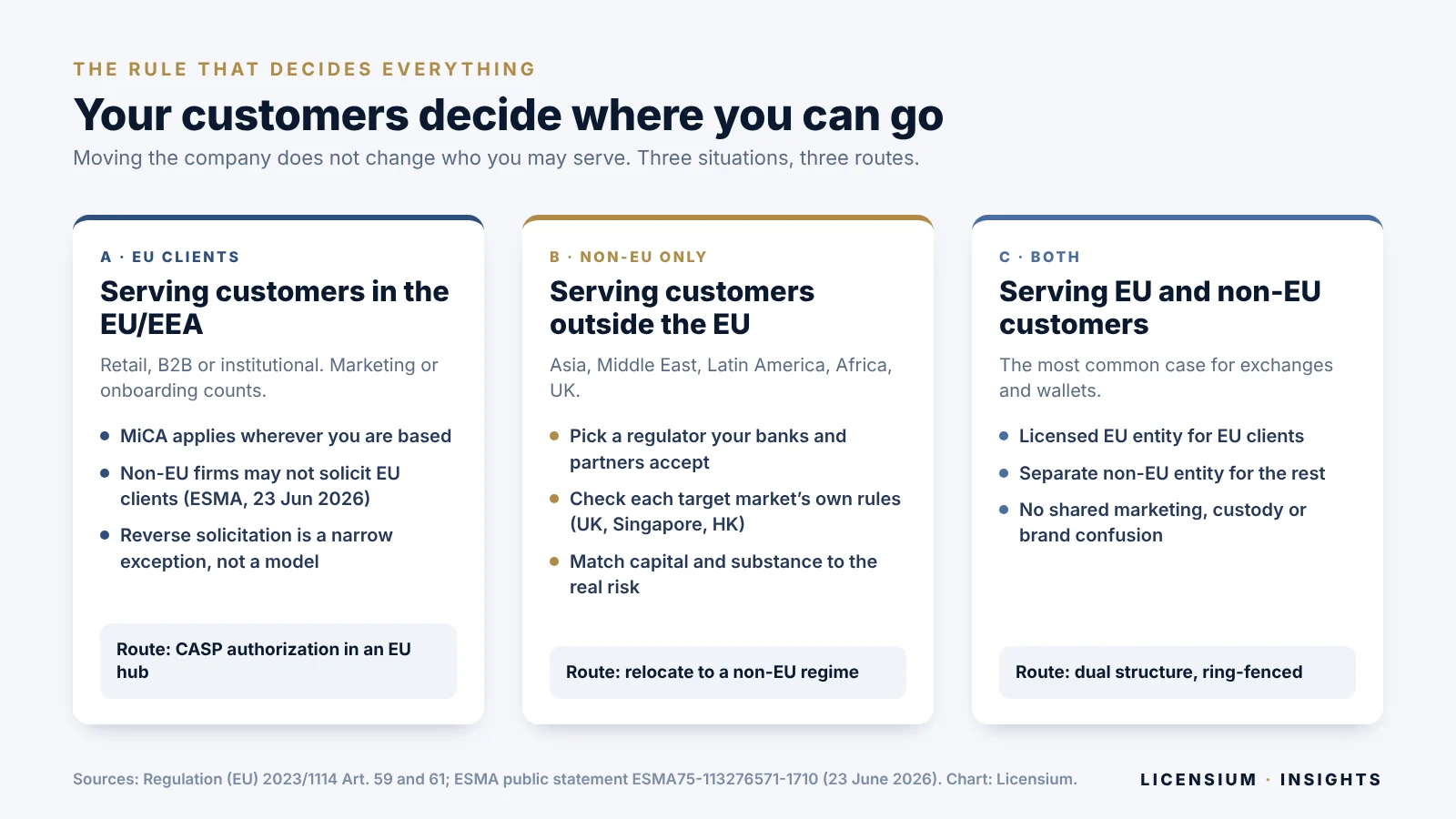
- Where your customers live decides everything. A non-EU company may not solicit EU clients, and ESMA says this applies in business-to-business dealings too. Relocating does not change it.
- Leaving works for businesses that serve customers outside the EU. Dubai, Hong Kong, the UK, Switzerland, the Cayman Islands and the Bahamas all offer real regulatory standing, each with different costs and clocks.
- Singapore is the cautionary tale. Since 30 June 2025 the MAS says it will generally not license firms that serve only overseas customers, so it is not an exit route.
- The UK window is open now and closes on 28 February 2027. The UK crypto regime goes live on 25 October 2027, and firms that do not apply must wind down their UK business.
- The best answer for many founders is two entities: a MiCA-authorized company for EU clients and a non-EU company for everyone else, with a clean separation between them.
1. Why are crypto founders leaving Europe after MiCA?
Every regulatory change produces refugees, and the end of MiCA’s transitional period on 1 July 2026 produced a particular kind. They are not the businesses that failed to qualify. They are the businesses that looked at the cost of qualifying and asked whether the European market was worth it.
The costs are real. A MiCA authorization requires a company with genuine management and substance in an EU country, minimum own funds of €50,000, €125,000 or €150,000 depending on the services (and a quarter of fixed overheads if that is higher), a compliance function, an ICT risk framework and a file that satisfies a national supervisor. We covered the economics in detail in our Spain market research, and the picture is similar in every hub: the license fee is the small number, the people and systems are the big one.
Sentiment in the industry reflects the pressure. At the end of June, the head of OKX Europe predicted that about 80% of crypto companies would not withstand MiCA, and claimed that around 60% of European crypto users were on platforms without authorization, according to The Block. Treat those numbers with care: he runs a licensed exchange and was giving a prediction, not publishing data. But the direction is clear, and so is the ESMA public statement of 23 June 2026: after 1 July, unauthorized providers must stop onboarding EU clients, stop marketing to them and limit themselves to closing out existing positions.
Some of the interest in leaving is therefore tactical (a firm that missed the window), some strategic (a firm whose customers are mostly outside Europe) and some simply emotional. Consultations at UAE advisers reportedly come several times a week, and more than half from Europe, according to a DigitalToday report that itself relies on secondary sources. The lesson for a founder is to separate the three motives early, because they lead to three different answers.
2. Can I serve EU customers from outside the EU?
Short answer: no, not as a business model. This is the single most important legal point in this guide, and the one most often misunderstood.
MiCA regulates the service, not the registered address. A crypto-asset service is regulated if it is provided to clients in the EU. A company incorporated in Dubai, Hong Kong or the Cayman Islands that opens accounts for EU residents, advertises to them or accepts them as customers is providing the service in the EU, and it needs a CASP authorization to do so. ESMA’s June 2026 statement spells this out: non-EU providers cannot provide MiCA services to EU clients or solicit them, and that includes business-to-business activity.
What is reverse solicitation, and can it save me?
Article 61 of MiCA contains one narrow exception. If an EU client approaches a third-country firm on the client’s own exclusive initiative, the firm may serve that client without authorization. Founders often read this as a back door. It is not one, and practitioner analysis of the ESMA guidelines explains why:
- Solicitation is defined broadly. Direct advertising, geo-targeted ads, country-specific SEO, paid influencers, sponsorship of EU events and EU-language websites with no commercial reason other than reaching EU clients can all count. Solicitation by a third party acting for you is attributed to you.
- It covers one relationship, one transaction type. A firm may only market services “of the same type” as the original contact, read narrowly. It is not a licence to maintain an EU client base.
- Re-engagement defeats it. Push notifications urging clients to return or trade more are indicators of active solicitation.
- You carry the burden of proof. Disclaimers do not override the facts, and national authorities are expected to monitor SEO and social media and to act on complaints and whistleblower reports.
The practical conclusion is blunt. Reverse solicitation is an exception for the occasional client, not a strategy for a business. If your plan depends on EU customers, relocation is not the answer.
What does ESMA say you cannot outsource?
One more detail that matters for structuring. ESMA’s statement says CASPs cannot delegate or outsource certain services, notably custody, to entities that are not authorized CASPs. A non-EU affiliate therefore cannot simply be the “custody back end” of an EU-licensed brand. If you build a two-entity structure, each entity needs a real, independent role.
3. Which businesses should actually leave the EU?
The decision is easier with a test. Ask four questions in this order.
| Question | If the answer is yes | If the answer is no |
|---|---|---|
| 1. Do EU/EEA residents make up a material share of clients or revenue? | You need an EU authorization for that business, or you must exit EU clients. Relocating alone does not solve it. | Continue to question 2. |
| 2. Are your target markets outside the EU regulated in their own right? | You need each market’s permission (for example the UK or Hong Kong), not just a home licence. | You have more freedom to choose a home regime. |
| 3. Do your banks, liquidity providers and institutional partners accept the regulator? | You can shortlist that regime. | Drop it. A license nobody banks against is a decoration. |
| 4. Can you staff real substance there? | Proceed to a feasibility check. | Choose a lighter regime or a partner structure. |
The pattern is that leaving is a good decision for three kinds of business: those whose customers are mainly in Asia, the Middle East, Africa or Latin America; those that are B2B with few EU clients and can geo-restrict cleanly; and those whose product (for example a token-issuance platform) fits another regime better than MiCA. It is a poor decision for retail businesses with a large EU base, and for any business that hopes to keep EU users “quietly”.
4. What are the best places to relocate a crypto business after MiCA?
We group the realistic destinations into four families: the Gulf, Asia, non-EU Europe and the offshore and Latin American regimes. For each we set out what the regulator actually requires and what the regime is good for. Indicative times and capital are Licensium planning ranges drawn from our jurisdiction pages, not statutory deadlines.
Dubai and the UAE: the most active destination
The UAE has three relevant regulators. The Dubai crypto license (VARA) covers virtual-asset activity across Dubai’s mainland and most free zones. Abu Dhabi’s ADGM is run by the FSRA and DIFC by the DFSA, each with its own rules. One tracker published in June 2026 by NeosLegal counted 100 firms with active virtual-asset licenses in the UAE, with 14 new licensees so far in 2026; it says VARA holds the largest share, with ADGM close behind. The tracker is a vendor’s marketing product, so verify against the regulators’ registers before relying on the number.
Why it works. A single-purpose regulator that issues licenses by activity, a federal corporate tax of 9% with no personal income tax, 100% foreign ownership and a time zone that connects Europe with Asia. Our indicative timeline is four to seven months, with capital from AED 100,000 to AED 500,000 or more depending on the activity.
Where it bites. VARA expects real substance and a credible compliance team in the emirate, and banks apply tough onboarding. A UAE license does not allow you to serve EU or UK clients. And licensing by activity means you must scope carefully: an exchange, a custodian and a broker-dealer are separate permissions.
Hong Kong: the slow, serious one
Hong Kong’s SFC virtual-asset trading platform (VATP) license is the standard against which many Asian regimes are measured. Our planning figures are paid-up capital of HK$5 million or more and nine to twelve months to approval. The regime is still expanding. According to a briefing by Stephenson Harwood, the HKMA granted its first two stablecoin issuer licences on 10 April 2026, and on 26 May 2026 the government confirmed standalone regimes for virtual-asset dealing, advisory and management, with a bill intended for the Legislative Council in 2026. Existing providers must be licensed by the commencement date, with no deeming arrangement, so firms without pre-application engagement may have to stop.
Why it works. Institutional credibility, access to professional and (for VATPs) retail investors in a major financial centre, and a supervisor with a clear rulebook. Where it bites. The time, the capital and the local substance. This is a route for well-funded exchanges and asset managers, not for a six-person startup.
Singapore: the exit that is closed
Founders sometimes ask whether they can move to Singapore and serve overseas customers from there. The MAS has answered. Its regime for digital token service providers took effect on 30 June 2025, and in its media release the regulator said that a firm serving only customers outside Singapore needs a licence, that it “has set the bar high for licensing and will generally not issue a licence”, and that existing providers serving only overseas customers must stop. Singapore remains attractive for firms that serve Singapore customers and hold the appropriate licence. It is not a place to hold an offshore business.
The United Kingdom: open now, with a deadline
The UK is outside the EU and outside MiCA, but it is building its own regime. According to Davis Polk, the FCA gateway opened on 30 September 2026 and the application window closes on 28 February 2027. The regime commences on 25 October 2027, and applications made in the window are expected to be decided before then. Applications made later are not expedited, and firms that do not apply must wind down their UK crypto business before the start date, because continuing risks breaching the general prohibition in section 19 of FSMA, a criminal offence.
The regime introduces regulated activities for issuing qualifying stablecoins, safeguarding cryptoassets, operating a trading platform, dealing as principal or agent, arranging deals and staking. For overseas firms the key point is that dealing, arranging or operating a trading platform from outside the UK counts as UK activity if it involves a UK consumer, so you must be authorized or stop serving UK consumers. Dealings with UK institutional clients are generally outside the authorization requirement.
For an EU exit this means: the UK is a market to enter, not a place to hide from MiCA. A firm leaving the EU that wants UK customers should calendar 28 February 2027 now.
Switzerland: strong standing, a moving target
Switzerland has no single crypto license. Depending on the business, you may need a FINMA authorization (for example as a securities firm or under the fintech licence) or affiliation to a self-regulatory organization (SRO) for anti-money-laundering supervision. The Federal Council opened a consultation on 22 October 2025, running until 6 February 2026, on two new categories: a payment instrument institution replacing the fintech licence and a crypto institution for providers of crypto services, according to the government’s announcement. It is a draft and has not taken effect, so plan on today’s rules and build flexibility for tomorrow’s.
Why it works. Reputation with banks and institutions, a mature ecosystem around Zug and a clear route for many intermediaries through SRO membership. Where it bites. Substance, cost (our planning figure is a typical CHF 100,000 or more, license-dependent) and the fact that Switzerland is outside the EU for MiCA purposes: Swiss firms need an EU authorization to serve EU clients.
Cayman Islands, BVI and the Bahamas: the offshore tier with rules
The era of the pure-paper offshore company is over. The Cayman Islands regulates virtual-asset service providers under its VASP Act, with CIMA registering or licensing them depending on activity; our planning ranges are a typical capital of US$25,000 to US$100,000 by tier and three to five months. The British Virgin Islands supervise virtual-asset businesses through the Financial Services Commission. The Bahamas rebuilt its framework after the FTX collapse: the Digital Assets and Registered Exchanges Act 2024 took effect on 29 July 2024 and the Securities Commission handles applications in categories such as exchanges, custodial wallet providers, staking, broker-dealers and token issuers, with a registered office and resident directors and compliance personnel, and a typical timeline of three to six months, according to Salvus.
Why they work. Common-law systems, tax neutrality and recognition with institutional counterparties, especially for funds and token structures. Where they bite. These are not EU, UK or US passports. They are home regulators, and your customers’ countries still apply their own rules. Banks also look hard at pure-offshore structures. See our broader offshore crypto license guide and our analysis of the future of offshore jurisdictions.
Latin America and the Caucasus: fast registrations with a specific job
These regimes are faster and cheaper, but they are narrower. They are AML registrations or purpose-built local statutes rather than global passports.
- El Salvador: a purpose-built statute, the 2023 Digital Assets Issuance Law, with the CNAD authorizing providers as a PSAD. Our planning estimate is 12 to 16 weeks. See the El Salvador guide.
- Costa Rica: Law 10.961 adds a VASP registration with SUGEF under the AML law. It is a registration, not a licence, but banks cannot deal with unregistered VASPs, so it effectively controls market access. CONASSIF implementing rules are due. See the Costa Rica guide.
- Panama: no dedicated crypto licence; a territorial tax system and the US dollar, with AML supervision. See Panama.
- Argentina: registration with the CNV in the PSAV registry under Law 27,739. See Argentina.
- Georgia: AML registration with 0% corporate tax under Virtual Zone status. See Georgia.
- Seychelles: a developing VASP framework under the FSA; confirm the current scope. See Seychelles and Labuan for Asia-facing structures.
5. How do the options compare?
The table below sets the main routes side by side. “Access” describes what the regime gives you beyond its own territory. The honest answer in most rows is: very little, which is why the customer test in section 3 comes first.
| Destination | Authority | Type | Indicative time | Capital (planning) | Best for |
|---|---|---|---|---|---|
| UAE (Dubai) | VARA | Activity-based license | 4–7 months | AED 100k–500k+ | Exchanges, custodians, brokers serving MENA and Asia |
| Hong Kong | SFC (HKMA for stablecoins) | VATP license | 9–12 months | HK$5m+ | Well-funded platforms and managers |
| Switzerland | FINMA / SRO | Authorization or SRO affiliation | 4–8 months | CHF 100k+ (license-dependent) | Institutional and banking-linked models |
| United Kingdom | FCA | New regime, live 25 Oct 2027 | Apply by 28 Feb 2027 | Set by FCA rules | Firms targeting UK consumers |
| Cayman Islands | CIMA | VASP registration or license | 3–5 months | US$25k–100k by tier | Funds, token structures, institutional counterparties |
| Bahamas | Securities Commission | DARE Act registration | 3–6 months | By category | Exchanges and token issuers with local presence |
| El Salvador | CNAD | PSAD license | 12–16 weeks | See guide | Bitcoin-native services, Americas |
| Costa Rica | SUGEF | AML registration (Law 10.961) | 3–6 months | No fixed capital | Central American service models |
| Panama / Georgia | AML supervisors | AML registration | 6–14 weeks | Low | Lean structures with limited licensing needs |
| EU hub (for comparison) | National authority | MiCA CASP | 3–8 months | €50k / €125k / €150k | Anyone serving EU clients |
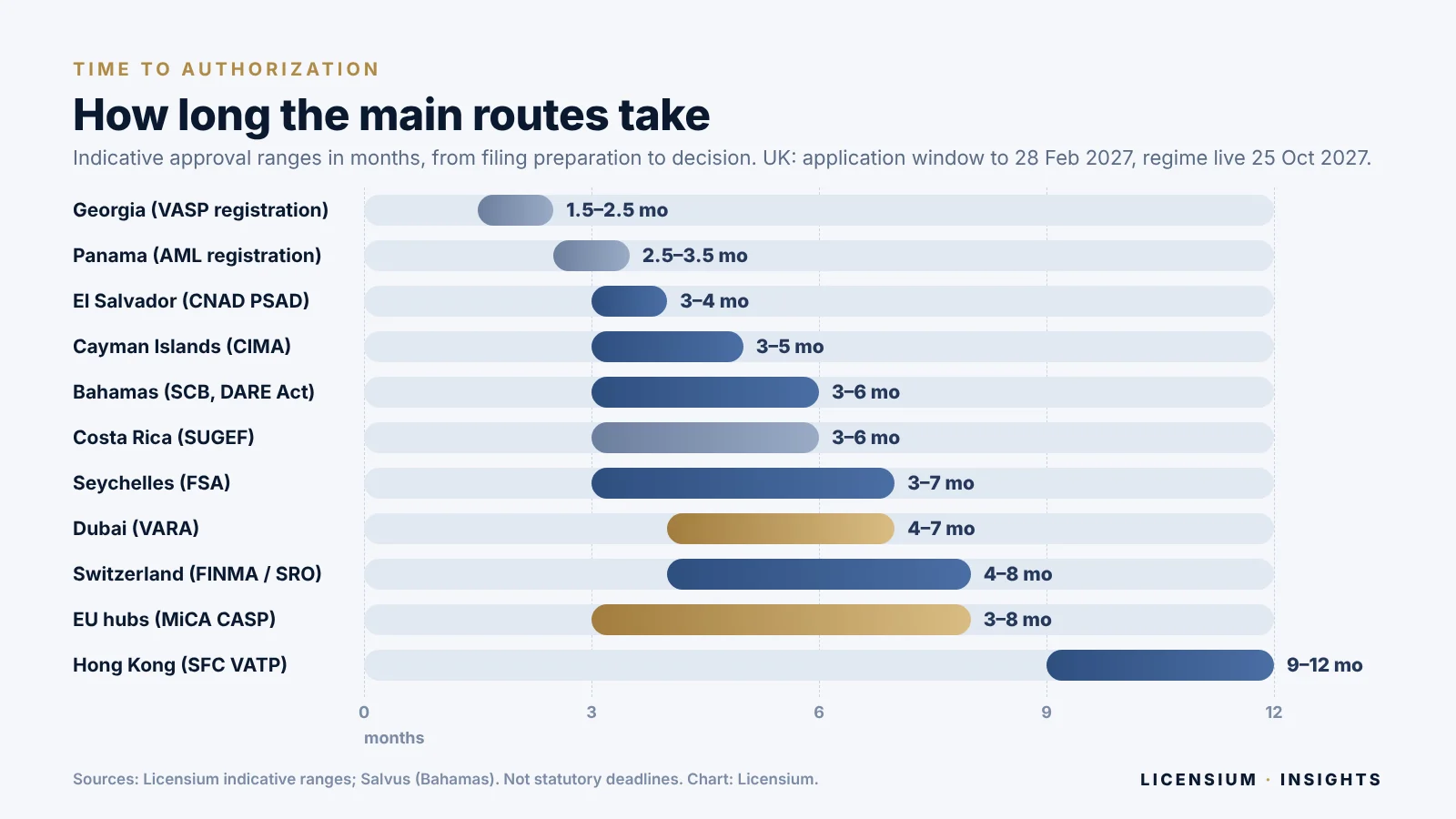
Two observations stand out. First, time is not the main differentiator: most routes cluster between three and eight months, once the file is ready. Second, the fast regimes at the left of the chart are fast because they ask for less. A faster registration is a sensible choice for a lean software or payments business, and a poor one for a platform that will hold client assets.
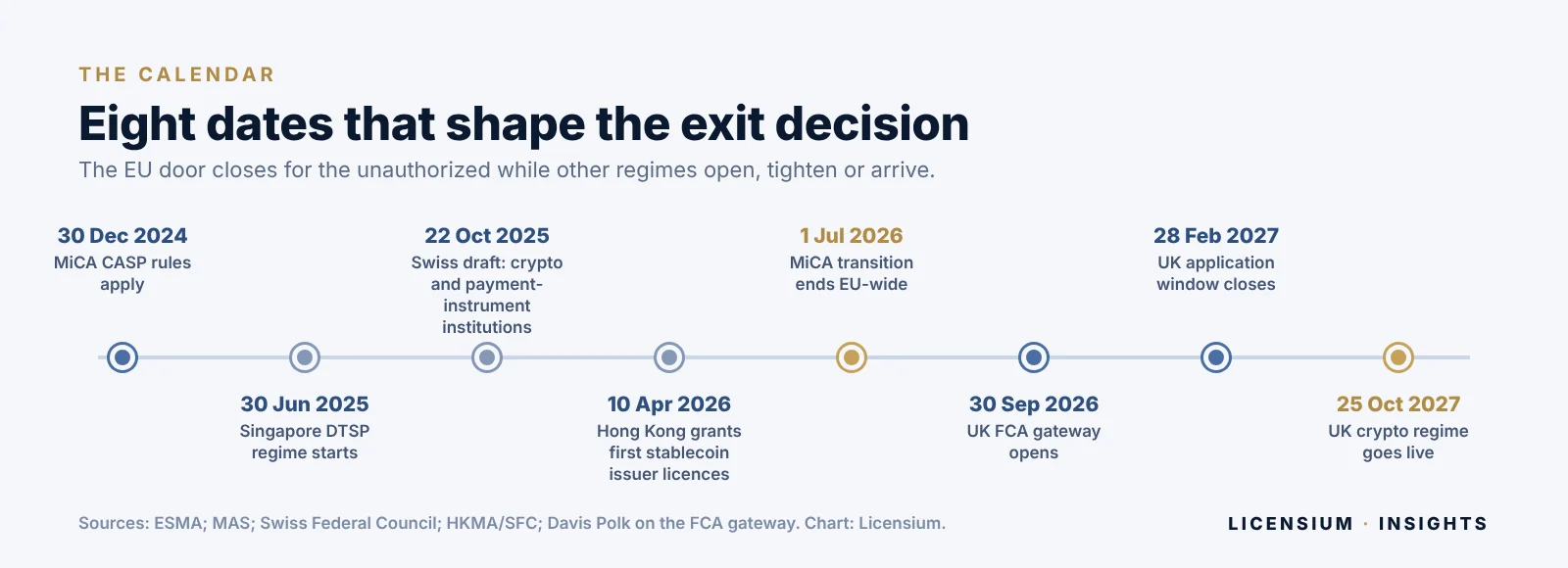
6. What does the calendar look like?
Timing is part of the decision, because several regimes are changing at once. The dates below are the ones we are watching with clients.
7. Worked examples: three founders, three answers
The examples below are composites based on common client situations. They are illustrations, not individual advice.
Example A: the retail exchange with 40% EU volume
Facts. A spot exchange registered in a country that gave it a national VASP registration, with about 40% of trading volume from EU residents, was planning to “move to Dubai”.
Analysis. Moving the parent to Dubai does nothing for the EU 40%. After 1 July 2026 those clients can only be served by an authorized CASP. Custody and exchange puts the business in the €125,000 own-funds class. The plan is a dual structure: a CASP in an EU hub for EU clients (see our guides to Lithuania, Cyprus and Spain), plus a VARA-licensed entity for Middle East and Asian clients. The two entities must be separate in capital, custody, staff and marketing.
Result. The founder keeps both markets, but accepts two compliance programmes. The saving comes from putting each client segment where the rules fit it.
Example B: the institutional OTC desk with 5% EU flow
Facts. A B2B over-the-counter desk serves funds and corporates in Asia and Latin America. Roughly 5% of notional comes from EU entities.
Analysis. Because ESMA applies the rule to B2B as well, the 5% is not a rounding error. The cleanest answer is to exit EU clients, geo-restrict onboarding and document the decision, then choose the best home regime for the other 95%. Hong Kong or Dubai would give the institutional standing counterparties want; the Cayman Islands could suit a fund-linked structure.
Result. No EU authorization is needed if EU clients are genuinely excluded, but the exclusion must be real: KYC that screens residence, no EU-targeted marketing, and a record that shows how any inbound request was handled.
Example C: the token platform with a global community
Facts. A project issues a utility token and runs a marketplace, with a global community and an anonymous-friendly culture.
Analysis. The relevant questions are the nature of the token, who it is offered to and where it is marketed. A public offer or admission to trading of crypto-assets in the EU triggers MiCA’s requirements, whatever the issuer’s location. A non-EU issuer can still use a Cayman or BVI structure for governance, but the offer needs to be designed around the EU question, not around the company’s postcode. Our asset tokenization services page covers how this plays out for tokenized assets.
Result. A foundation and operating company in an offshore regime, with explicit geographic terms, and an EU-compliant path if and when the project wants EU users.
8. What are the hidden traps when you relocate?
Founders usually ask about the license. The problems that sink relocations are elsewhere.
- Banking. A regulator’s approval does not open a bank account. Banks assess ownership, source of funds, the licence, and your compliance staff. Start the conversation before filing. Our business bank account guide and banking support explain the process.
- Substance. Dubai, Hong Kong, Switzerland and the Bahamas all expect real people making real decisions locally. A virtual office is a red flag.
- Marketing is evidence. If your site is translated into Spanish, German and Italian, runs EU ads and sponsors a European football club, a regulator can treat that as solicitation, whatever the terms of service say.
- The wind-down you owe. If you must leave EU clients, ESMA expects a written wind-down plan, clear and repeated client communication, a deadline for closing residual positions and continued AML controls during the exit. A disorderly exit can create client claims.
- Tax. Moving management or intellectual property can change tax residency and trigger exit or controlled-foreign-company rules in the country you leave. Take tax advice before you move anything. Our tax structuring team works on this alongside the licence.
- Reporting. The EU’s DAC8 directive has obliged crypto-asset service providers to report user data to tax authorities since 1 January 2026, and the Travel Rule applies in all the major regimes. A non-EU home does not remove your counterparties’ reporting obligations.
- Continuity. A new regulator will test your AML programme, your risk assessment and your incident response before it approves you. Build these as live systems, not documents. See our AML/KYC checklist.
9. How do you choose? A seven-step decision framework
We use the same sequence with every client. It takes a week and often changes the plan.
- Map your clients by residence for the last twelve months and for your forecast. Be specific about the EU/EEA share.
- Map your services to regulated activities: custody, exchange, trading platform, execution, transfer, advice, staking, issuance.
- List your target markets and their rules. The UK, Hong Kong and Singapore each regulate service to their own residents.
- Shortlist two or three regimes and test them against banking, liquidity and institutional partners.
- Cost the real budget, not the fee: people, systems, local office, audit and insurance.
- Design the structure: one entity or two, where custody sits, where staff sit, how marketing is separated.
- Plan the exit from what you leave: client communication, wind-down timeline, tax and contracts.
10. What does a 90-day plan look like?
| Phase | Weeks | What happens |
|---|---|---|
| 1. Diagnose | 1–2 | Client and revenue mapping by residence, service scoping, regime shortlist, preliminary tax view. |
| 2. Decide and design | 3–4 | Choose the regime(s); design entities, custody, governance and marketing separation; open banking conversations. |
| 3. Build the file | 5–10 | Company set-up, local office and directors, AML/CFT manual, risk assessment, ICT and custody policies, business plan and financial projections. |
| 4. File and exit EU clients | 8–12 | Submit the application; publish the client communication and wind-down timeline if EU clients are being exited. |
| 5. Review and launch | After filing | Respond to the regulator’s questions; finalize banking; launch only the activities the licence covers. |
The regulator’s review clock is separate and starts only when the file is complete, which is why the preparation phase is where time is won or lost. If you want a second opinion on the structure, our team can run the first two phases as a short engagement, and our VASP license guide and global crypto license hub show the options in more detail.
11. Should you stay in Europe after all?
Sometimes the best relocation is a different European city. The register tells the story: after the transition, ESMA’s interim register held several hundred authorized providers, with a few countries holding most of them, as our market research on the EU crypto industry sets out. The hubs differ in speed, culture and cost, and our guide to choosing the right crypto license jurisdiction compares them.
A short list of where an EU authorization is worth the effort:
- You serve EU retail clients. There is no substitute.
- You want the EU passport. One authorization is valid across 30 EU/EEA states, for the services named in it.
- You need EU banks and institutions. A MiCA license is the credential they ask for first. See our EU crypto license guide.
- You want a lower-profile, less crowded hub. Our Spain guide explains why Madrid is attracting attention, while Malta, the Czech Republic and Slovakia offer other trade-offs.
One caution on Poland: the national MiCA act had not entered into force at the latest information we have, so businesses targeting Polish customers have generally obtained authorization in another member state and notified Poland. Our Poland page sets out the current position.
12. Frequently asked questions
Where is the best place to move a crypto business after MiCA?
There is no single best place. If most of your customers are outside the EU, Dubai (VARA) and Hong Kong (SFC) are the strongest regulated options, with Switzerland, the Cayman Islands and the Bahamas as alternatives. If a meaningful share of customers is in the EU, you need a MiCA authorization in an EU country instead of, or in addition to, a non-EU entity.
Can a non-EU crypto company serve EU customers?
Not without a CASP authorization. ESMA’s statement of 23 June 2026 says non-EU providers cannot provide MiCA services to EU clients or solicit them, including in B2B dealings. The only exception is reverse solicitation, which covers services provided strictly at the client’s own exclusive initiative and is read narrowly.
Is Dubai a good alternative to a MiCA license?
It is a good alternative for serving clients outside the EU, not for serving clients in it. A VARA license gives you regulatory standing in Dubai and credibility in the Gulf and Asia, but it does not authorize you to offer services to EU residents.
Why is Singapore not an option for an offshore crypto business?
Because the MAS has said it will generally not issue licences to digital token service providers that serve only customers outside Singapore, and existing providers in that position had to stop when the regime started on 30 June 2025.
What is the UK’s crypto regime and when must I apply?
The UK is introducing FCA authorization for activities such as operating a trading platform, safeguarding, dealing and arranging, and staking. The gateway opened on 30 September 2026 and closes on 28 February 2027, and the regime goes live on 25 October 2027. Firms that do not apply must wind down their UK crypto business before that date.
Which is faster: a non-EU license or a MiCA authorization?
The registrations in Georgia, Panama and Costa Rica can be faster than a MiCA file, but they ask for less and give less. For the full licensing routes (EU hubs, Dubai, Switzerland, the Cayman Islands, the Bahamas) the realistic range is about three to eight months once the file is ready, and Hong Kong is longer, at nine to twelve.
Can I keep a legacy EU client base while I wait for a license?
No. After 1 July 2026 ESMA expects unauthorized providers to stop onboarding and marketing to EU clients and to wind down, with a plan, client notices and a deadline for residual positions. Applying for a license does not extend the transitional period.
Do I need two companies if I serve both EU and non-EU customers?
In most cases, yes. A MiCA-authorized entity for EU clients and a non-EU entity for the rest is the common structure. The entities need separate substance, custody and marketing, because ESMA does not allow custody and other core services to be delegated to unauthorized entities.
Will Licensium help us compare options?
Yes. We run feasibility checks, structure the entities and prepare the files for EU and non-EU regimes. Start with a short call through the contact page and we will tell you plainly if the answer is to stay.
Sources
- ESMA — Public statement: MiCA transitional period ends (23 June 2026)
- Ecovis — Reverse solicitation after MiCA’s transitional period
- EUR-Lex — Regulation (EU) 2023/1114 (MiCA)
- The Block — OKX Europe chief says 80% of crypto exchanges won’t survive MiCA
- DigitalToday — EU MiCA rules drive crypto firms’ exodus to Dubai
- NeosLegal — UAE Crypto License Tracker 2026 (press release)
- Stephenson Harwood — Virtual assets in Hong Kong: two major developments in 2026
- MAS — Clarifies regulatory regime for digital token service providers
- Davis Polk — FCA’s cryptoasset authorisation gateway now open
- Swiss Federal Council — Stablecoins and crypto: consultation launched (22 Oct 2025)
- Salvus — Registering a digital asset business in the Bahamas in 2026
- Consortium Legal — Costa Rica introduces a VASP framework
- LegalBison — Important changes to Costa Rica VASP regime
- Icon Partners — Crypto license in Poland: current CASP status
Licensium planning ranges for time and capital are indicative and are not statutory deadlines or official fees. This article is journalistic analysis based on public sources and is not legal, tax or investment advice.